Background
I was the lead content designer for the Account & Risk team, focused on improving how we communicate security features to users.
The goal was not just to rewrite copy. It was to strengthen user trust in high-risk situations involving:
Asset protection
Scam prevention
Account recovery
I led content design for two key security features:
Emergency Contact (asset recovery and inheritance support)
Anti-Phishing Code (email and SMS verification protection)
Both features were technically sound. However, the language did not clearly communicate their value, limitations, or the level of control users retained. As a result, these security tools felt complex rather than protective.
1. Security features felt technical, not trustworthy
In crypto, ambiguity creates fear and disengagement. Both flows focused on functionality, not reassurance. Users were left wondering:
What exactly does this do?
What happens after I turn this on?
Am I giving someone access to my assets?
Is this really necessary?
2. Missing value proposition and cognitive overload
Across both flows, sentences were long, labels were repetitive, and technical terms were introduced without explanation.
In the anti-phishing code feature, the benefit was buried in long sentences, the urgency felt generic. Users also did not clearly understand how it protected them.
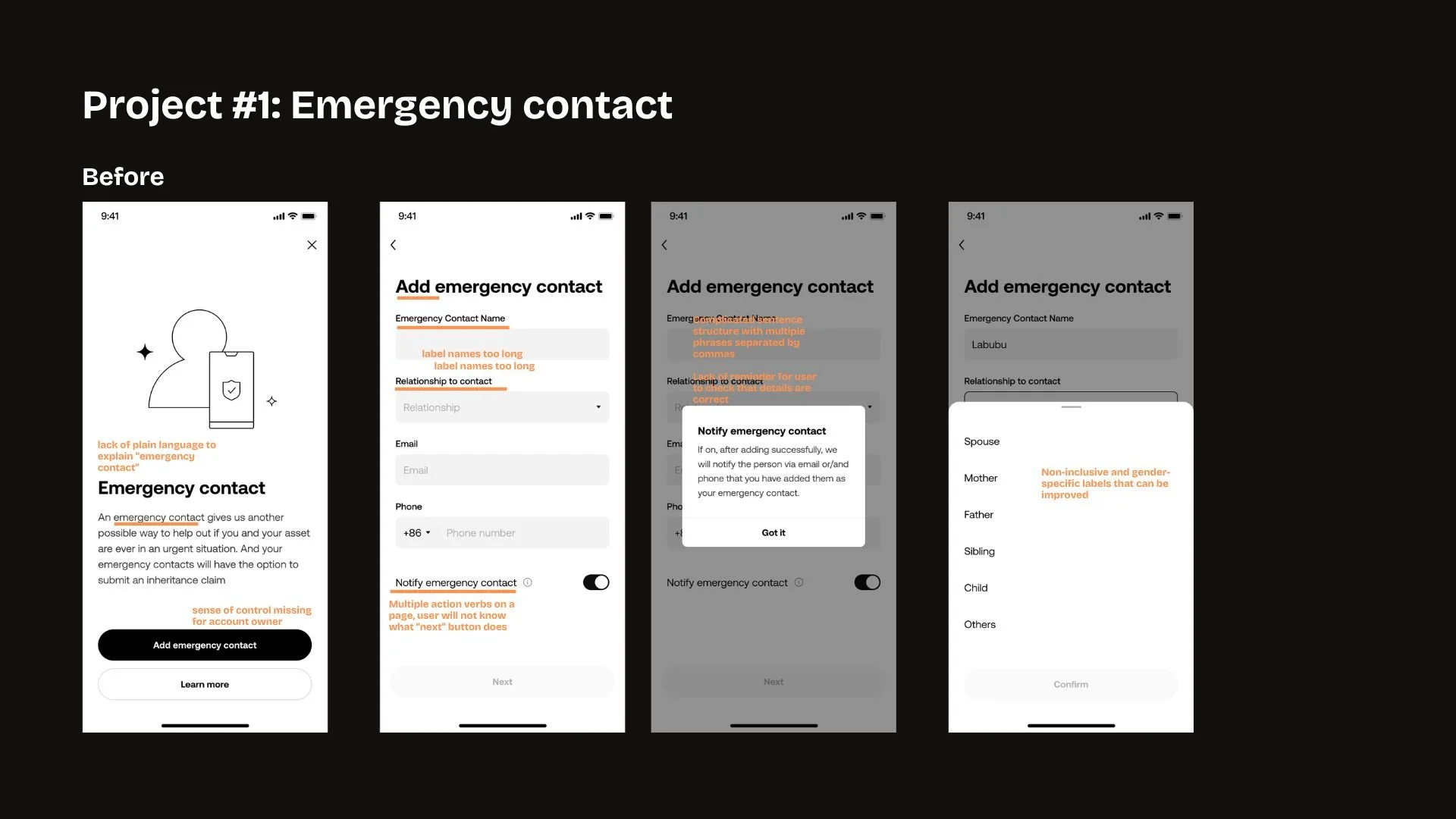
In the emergency contact flow, the concept was unfamiliar. "Emergency contact" was not defined in plain language and control cues were weak.
3. Inconsistent copy and AI-generated drafts
Many PMs used AI tools to draft copy directly in PRDs. This made writing faster, but it created inconsistency. Different terms were used for similar concepts, tone and structure varied across features, and there was no shared glossary for security terms.
Each draft sounded reasonable on its own, but did not align with the broader system. Over time, this weakened consistency across Account & Risk features.
To fix this, I focused on strengthening value messaging and improving alignment across the entire security system.
Challenges
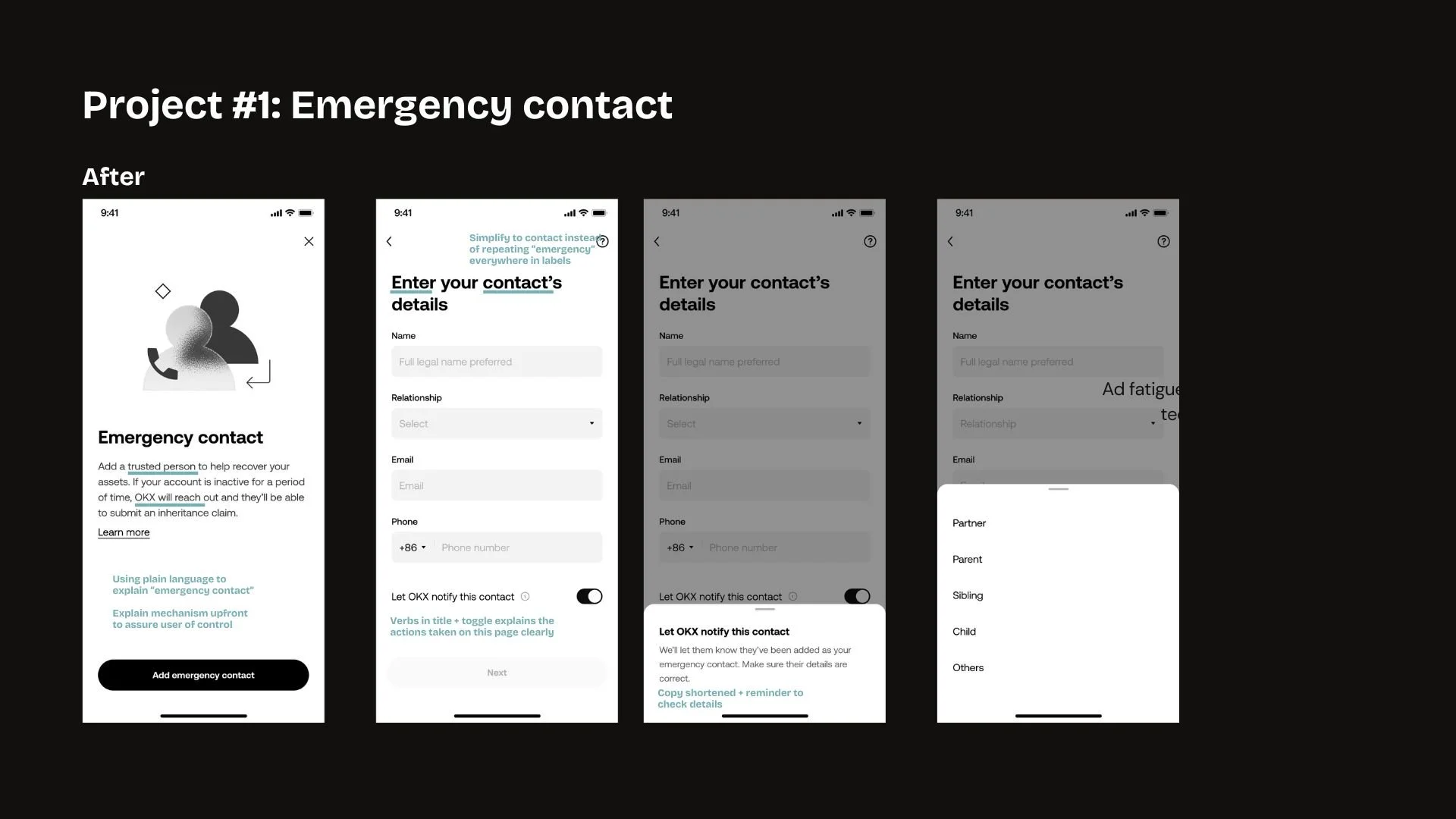
Emergency contact
What I changed:
(a) Rewrote the intro to clearly explain:A trusted person can help initiate recovery if the account is inactive.
They do not gain immediate access to assets.
(b) Simplified labels:
Removed repeated use of "emergency"
Shortened field names
(c) Strengthened control cues:
Clearly explained when the contact is notified
Added reminders before confirmation
(d) Made relationship options inclusive:
Partner, Parent, Sibling, Child, Others
(e) Created a dedicated FAQ page to explain rights, limits, and removal.
Result:
The feature shifted from feeling risky to feeling protective.
Solutions
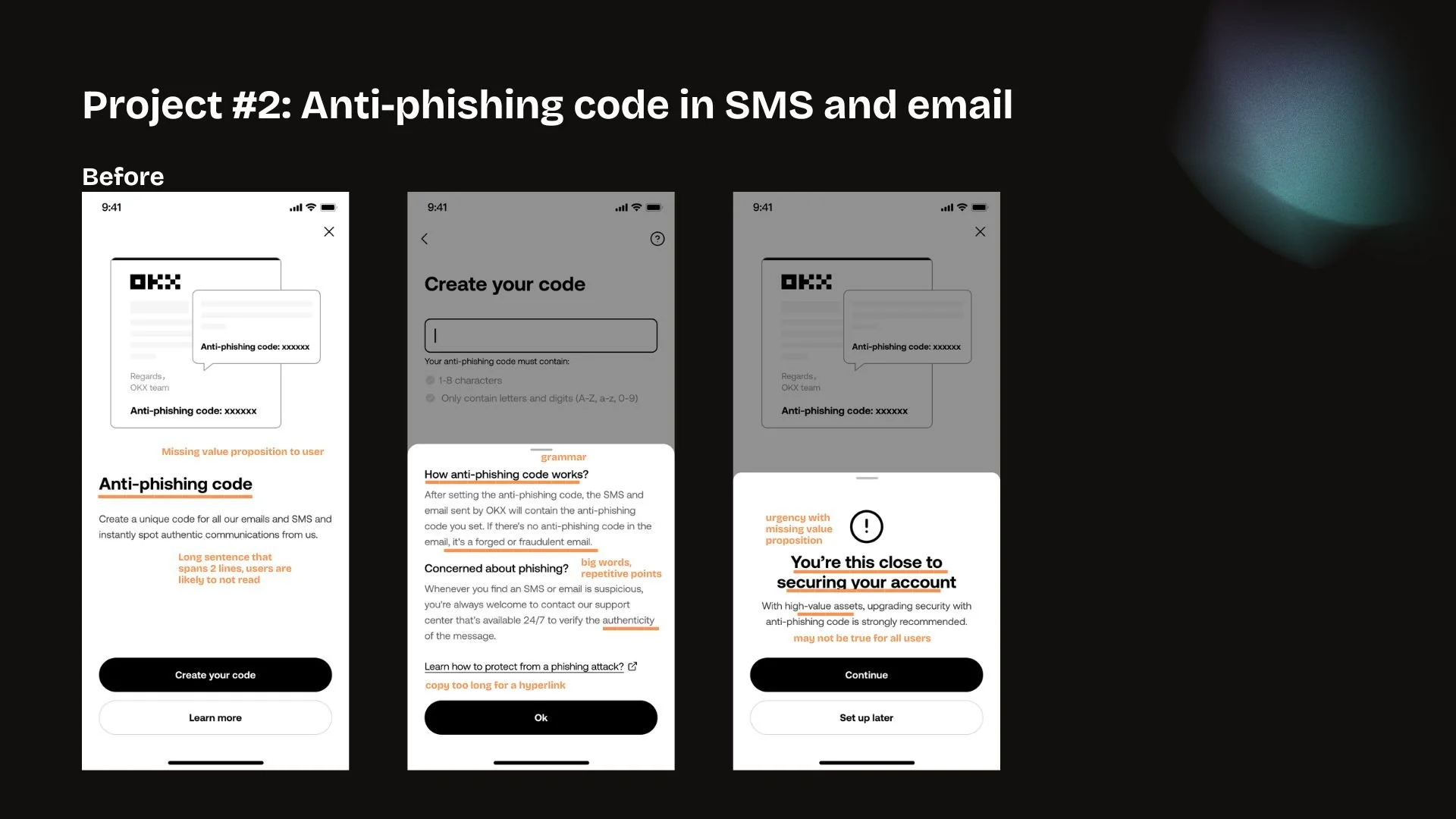
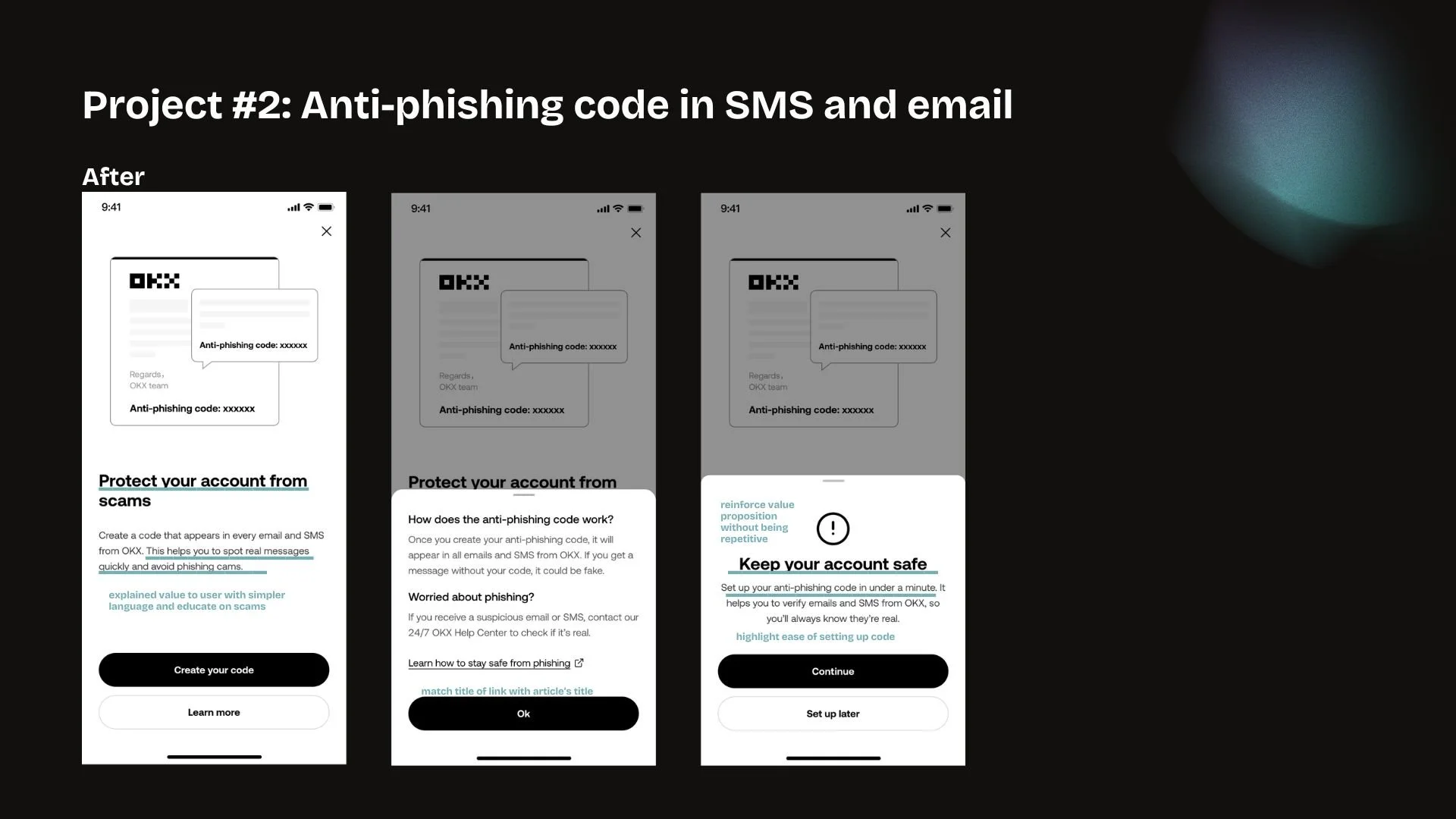
2. Anti-phishing code
What I changed:
(a) Reframed the headline to focus on user benefit:
"Protect your account from scams"
(b) Simplified the explanation:
The code appears in every official email and SMS.
If a message does not include your code, it may be fake.
(c) Reduced sentence length and removed repetition.
(d) Highlighted ease of setup: "Set up in under a minute."
(e) Improved the educational modal with short, direct guidance.
Result:
The feature became clearer, more actionable, and easier to trust.
Impact
Across both initiatives:
Improved user trust in security flows
Security features became easier to understand and less intimidating.
Reduced cognitive load with shorter sentences, clearer hierarchy.
Aligned product, support, and FAQ messaging for consistent security communication.
Users now clearly understand:
How features protect them
When actions happen
What control they retain
In crypto, trust is the product. Security features cannot feel confusing or technical. They must feel protective, transparent, and user-controlled. By reframing and simplifying high-risk flows, I helped shift security from: Technical configuration → User empowerment.